
Complete Guide to Adult Incontinence Underwear: Materials, Fit & Absorbency
Discover how adult diaper materials, fit, and absorbency affect comfort, odor control, and skin protection for daily confidence.
Understanding how the materials of adult diapers affect comfort and skin health—from soft non-woven fabric to SAP absorbent cores—helps you choose a more reassuring and reliable product.
Choosing adult diapers is not just about absorption capacity. Materials and structure also determine the long-term usage experience.
What Are Adult Diapers?
Adult diapers are a special kind of underwear designed for adults (both men and women) who experience urine or fecal leakage (incontinence). The inner lining contains an ultra-absorbent polymer (SAP), known as sodium polyacrylate.
Under ideal conditions (pure water, no pressure), sodium polyacrylate can typically absorb about 300 to 1000 times its own weight in water. However, in actual usage, due to urine composition and body pressure—especially the effects of salt and compression—its absorption capacity is usually 30 to 80 times its own weight.
To make real-world absorption performance closer to ideal conditions, SUNKISS selects FSC-certified wood pulp (fluff pulp) to facilitate rapid fluid distribution within the SAP absorption layer. This helps prevent clumping, allowing liquid to spread evenly so the core can absorb more effectively and reduce the risk of leakage.
What Are the Components of Adult Diapers?
- Top Sheet
- ADL (Absorbent Drainage Layer)
- Absorption Core
- Backsheet
- Fixing System
Studies have shown that multi-layer absorbent structures help shorten the time liquid remains on the surface, thereby reducing the risk of prolonged skin exposure to a damp environment.
Skin Problems Caused by Incontinence
Urinary incontinence-associated dermatitis (IAD) is a skin condition caused by multiple factors, including moisture, friction, pH changes, and chemical irritation from urine or feces. Among these, prolonged moisture and friction are widely regarded as the most critical triggers, and their combination significantly weakens the skin barrier.
Research data shows that approximately 5% to 50% of individuals with incontinence develop IAD, and this proportion is typically 20% to 40% in medical and care institutions. For middle-aged and elderly individuals (generally over 60 years old), the risk further increases due to thinner and more fragile skin.
SUNKISS products feature a breathable, skin-friendly non-woven surface combined with a multi-layer structure integrating an SAP absorbent core and a breathable backsheet. This design helps reduce redness, swelling, indentation, and sensitivity caused by friction, minimizes clumping, reduces the risk of rewetting under movement or pressure, promotes airflow, and helps keep skin dry and comfortable.
What Type of Backsheet Is More Suitable for Me?
The backsheet determines both comfort and protection during wear.
Common types in the industry:
- Plastic backsheet (PE): strong leak protection but not breathable
- Cloth-like backsheet: more breathable and comfortable
SUNKISS solutions:
- Breathable non-woven backsheet (more comfortable)
- High-barrier plastic backsheet (better leak prevention)
Which Type of Fastening System Won’t Leak?
The fixing method affects fit and leak-proof performance.
Common in the industry:
- One-time adhesive
- Velcro (reusable)
SUNKISS choice:
High-strength Velcro system (hook & loop)
- Can be adjusted multiple times
- Not easy to loosen
- Fits the body more closely
A secure fit helps reduce side leakage caused by shifting or loosening.
No Odor After Use?
SUNKISS design:
SAP adsorption + breathable structure + deodorization system
Through the combined effect of SAP’s efficient absorption, breathable structure, and deodorization system, moisture is locked in and odor spread is reduced, helping maintain freshness and comfort even after use.
How to Choose the Right Adult Diaper for You?
Clinical nursing guidelines indicate that keeping the skin dry is key to preventing moisture-associated skin damage (MASD). It is generally recommended to change every 3–4 hours, or immediately after dampness is noticed, to help maintain skin barrier health and reduce the risk of irritation.
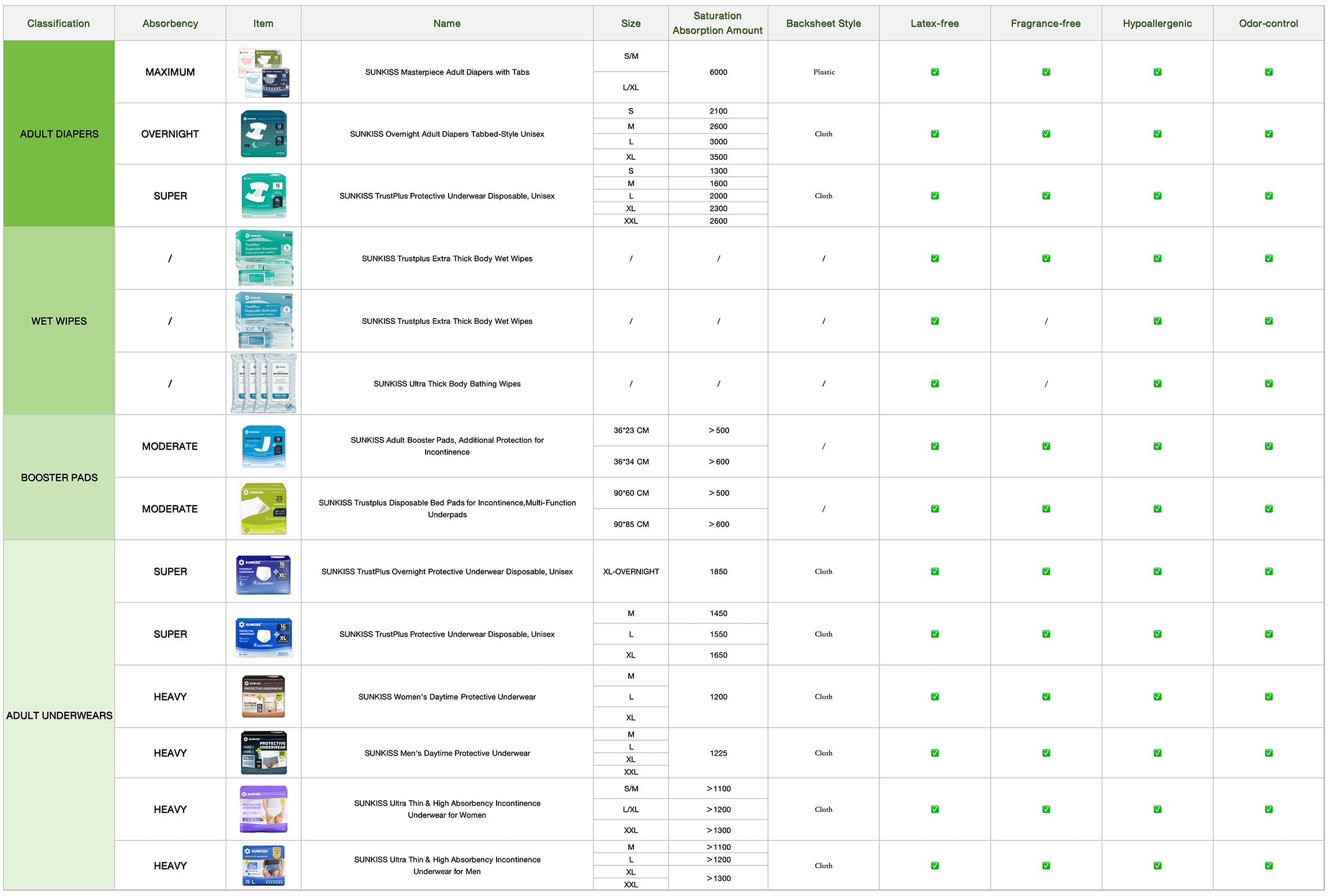
Find Your Fit



1 Kommentar
Lorna
How do you know front from back in the xxl underwear? There is nothin indicating front from back. All the other brands have the size stamp on them which is commenly the back of clothing. At least the packaging or web site should indicate.
You speedy response will determine if I purchace your product again.
How do you know front from back in the xxl underwear? There is nothin indicating front from back. All the other brands have the size stamp on them which is commenly the back of clothing. At least the packaging or web site should indicate.
You speedy response will determine if I purchace your product again.